
Do★Math 数学博物館 Mathematics Museum
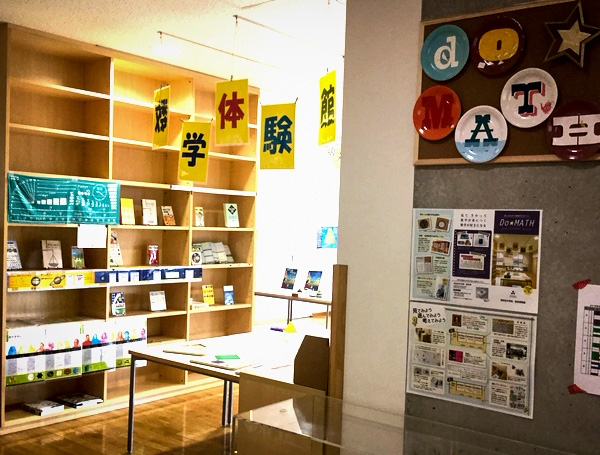
数学科メディアスペースにある、数学だけの博物館では、昔使われていた携帯そろばんや鯨尺ものさし、ピタゴラスの定理パズルや展開・因数分解パズルなど、数学にまつわるさまざまなものを展示をしています。
「Do★Math 数学博物館」からのお知らせ
私たちは、算数・数学を手に触れたり、パズルやゲームでわかりやすく、そして楽しみながら理解できる「Do★Math 同志社中学校数学博物館」を2016年5月にオープンいたしました。展示物の多くを並べた数学科オープンスペース(「数学メディアスペース」)を中心に、数学教室ゾーンを総称して、Do★Mathです。
このページでは、ブログでDo★Mathの展示物を皆さんに紹介していきます。展示内容を知っていただくとともに、数学読み物としても楽しめる連載にしていきたいと考えています。
発行は月2回不定期に、月日を合わせた3ないし4ケタの数字が素数の日に発信します。例えば、5月23日は523と表すことになり、523は素数です。
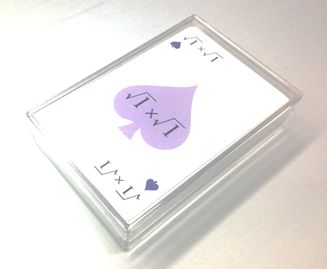
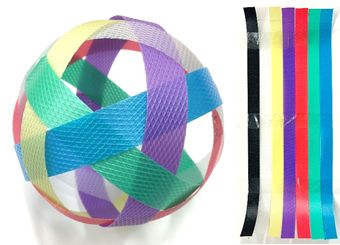
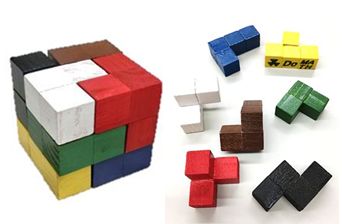
★3種類まとめて購入すると、送料無料!
(2026年1月よりソーマキューブの価格を1セット200円を300円に改定いたしました。)

3Dプリンタで作った、球の体積(公式)を積分的に説明する教具です。スイカを小さく分けたイメージ、球を小さな角すいの集まりとして体積を考えていきます。
マトリョーシカ人形は相似形
今日10月31日を1031と4ケタの数で表すと、1031は素数です。西暦を含めた20171031は、3と37と181721という3つの素数で割り切れるので、素数ではありません。
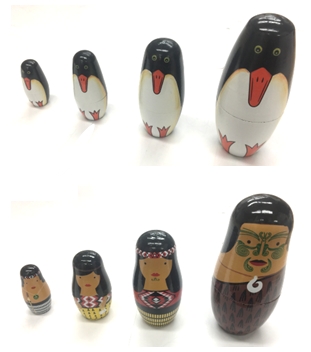 ご存じの方も多いと思いますが、「マトリョーシカ人形」(ロシア語: Матрёшк、英語: Matryoshka doll)はロシアの民芸品です。
2分割の人形が3~5個重なったしくみになっており、外側の人形の上半身を外すと、小さい人形が次々に現れるようになっています。
それぞれの大きさの人形のサイズを測ってみると、だいたい相似の関係にありました。高さや円周の長さの比がほぼ同じだということです。
マトリョーシカという名称は、ロシアの女性名からきていて、スカーフ姿の若い女性の像が描かれているデザインがポピュラーですが、レーニンをはじめロシア・ソ連の歴代指導者が描かれたものや、動物など人間以外のものが描かれたものなど、絵柄は多様化してきています。本校では一般的なデザインの他、国立新美術館(東京)で購入したペンギンやマオリ族をデザインしたマトリョーシカ人形も3階MS(メディアスペース)に展示しています。また、日本にもマトリョーシカ人形と同じ作りでだるまなどの入れ子人形があります。
(数学科 園田)
“Matryoshka dolls are similar figures.”
Many Japanese people know that Matryoshka dolls are a folk craft made in Russia. The biggest doll includes 3 or 5 similar figures. When I measure the size, height and length of the circumference, of every doll, it is similar.
The name “Matryoshka”is named after a name of Russian lady, so the design of the scarf is popular with young ladies. Recently there are various designs, for example, leaders of Russia like Lenin and animals. We have a set of normal design’s, penguin’s and Maori people on the third floor in Do★MATH.
Please check it!
by Tsuyoshi Sonoda (Math Dept.)
2進法ソーター
今日10月21日を1021と4ケタの数で表すと、1021は素数です。西暦を含めた20171021は13で割り切れるので、素数ではありません。(10/21は土曜日のため、今回は10/23に発信しました。)
東京理科大学数学体験館の講座で「2進数ソーター」というツールを紹介され、本校でも作ってみました。これは、本ブログ2016年9月7日付で紹介した『誕生日当てゲーム』と原理は同じです。
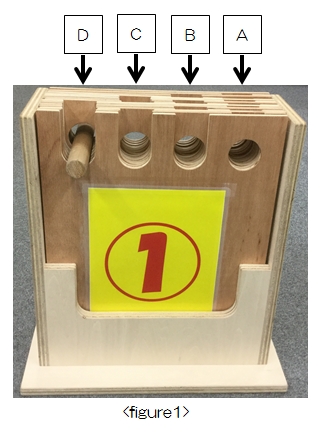
右下のA~Dのカードは、ある規則を持った数の集まりです。
まず、相手に1から15までで好きな数を1つ思い浮かべてもらいます。次に、その数がAからDのカードに書いてあるかないかを順に聞いていきます。
原理を知っている人は、ここまでで相手の考えている数がわかります。今回は2進法ソーターがそれを当てます。
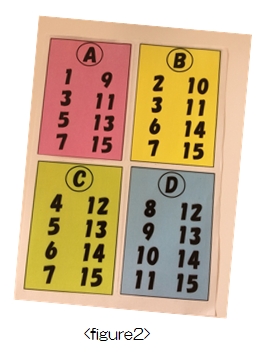
2進数ソーター(右写真)には1から15までの数が書かれた板が手前から奥に入っています。この遊び方を「10」の場合で紹介します。10はBとDのカードにあり、AとCにはありません。
2進法ソーターの穴は右からAからDに対応しています。右から順に(B、Dの順)、10があるカードの記号の穴に棒を入れて板を持ち上げます。棒にひっかかったパネルを持ち上げ、手前に持ってきます。
これで10が1番前に出てきて、見事に当てることができました。
Do★MATHに展示していますので、ぜひチャレンジしてみてください。
(数学科 園田)
“Card sorter to guess the number”
Today, we will introduce about a game tool to guess the number using a binary system.
The game tool (figure1) consists of 15 panels with the numbers 1 to 15 written on them. There are 4 holes in each panel corresponding to “A” through ”D”. We can play the game by using this tool and 4 cards (figure2) that show different numbers each other.
First, the player chooses a number and the cards that show that number. For example, if the players chooses 10. the number is written on cards “B” and ”D”.
Then, we put a wooden pole into the holes in the panels and pull them up and put those panels in the front. Lastly, the panel that shows the number 10 will be in the front.
 This game tool applies the binary number system used by computers. We introduced other game in our blog on September 7th, 2016. It has a same principle with this card sorter.
We exhibits it in Do★MATH.
Let’s try it together!
by Tsuyoshi Sonoda (Math Dept.)
自然数の3乗の和はどうなる?
今日9月19日を919と3ケタの数で表すと、919は素数です。西暦を含めた20170919は1009と19991という2つの素数の積で表されるので、素数ではありません。
13+23+33+・・・+○3 = ?
この合計はいくつになるでしょうか。
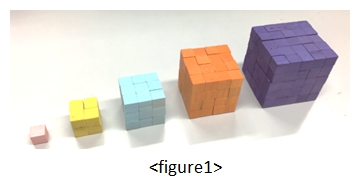
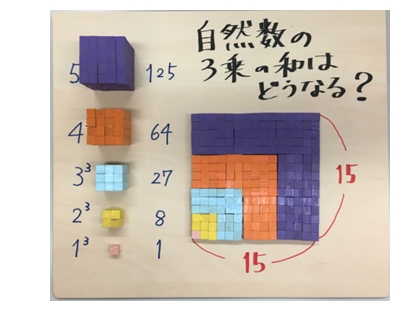
上の模型(fig.1)は、○=5 の場合を小さな立方体のピースで表したものです。
すべての小さな立方体の合計は、
13+23+33+43+53
=1+8+27+64+125
=225 (個)
となりますね。
この模型は、○=5 の場合のものなので、5 という数に注目してください。
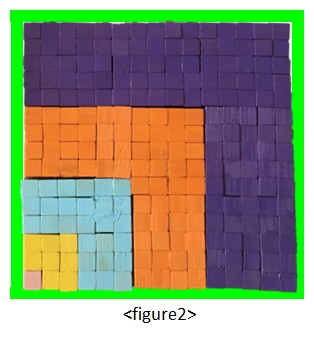
この模型を平面上に並べると、なんと正方形が出現します! (fig.2)
だから、合計は
13+23+33+43+53
(1+2+3+4+5)2
=152
=225(個)
と求めることができますね。
また、高校では以下の公式を学びます。
{○×(○+1)÷2}²
(数学科 園田)
“What is the sum of natural numbers cubed?”
Let’s talk about the sum of natural numbers cubed.
13+23+33+・・・+○3 = ?
We will think about above expression.
I show the model in the case of n = 5 shown in fig.1.
The sum of small cubes looks like this.
13+23+33+43+53
=1+8+27+64+125
=225 (pieces)
Next, I put the all pieces of cube on a plane, those make a square. (fig.2)
Then we can find the sum of small cubes like this.
13+23+33+43+53
(1+2+3+4+5)2
=152
=225 (pieces)
So we also can get the following formula.
{○×(○+1)÷2}2
by Tsuyoshi Sonoda (Math Dept.)
展開・因数分解パズル3
今日9月7日を907と3ケタの数で表すと、907は素数です。西暦を含めた20170907は823と24509という2つの素数で割り切れるので、素数ではありません。3ケタ以上の素数はプログラムを用いないとすぐには発見できませんね。
展開・因数分解パズルの第3弾です。
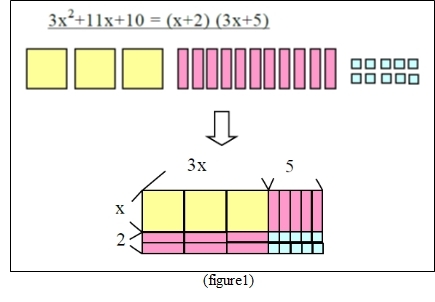 前回のお話で、このパズルが展開・因数分解をイメージしているものであることはおわかりいただけたと思います。
そして、このパズルをより抽象的、象徴的に表したものが面積図や直積表と呼んでいるものになります。
(figure2、figure3)
皆さん、今までは式の中の数値が「+」(プラス)であることを前提にお話をすすめてきましたが、今回は、項がに「-」(マイナス)があるとき(係数や定数項が負の場合)について考えてみます。実は、今までと同じように直積表で解決することができます。「+」(プラス)のときと同じように長さとして考えればよいのです。
x2+5x-14 の因数分解について、実際に解きながら考えてみましょう。
まず、x2 と -14 を直積表の左上と右下に記入します。-14 は負の項なので、直積表では赤い枠で表現しています。
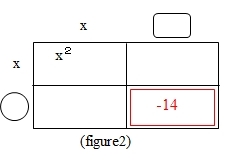 かけて-14になる数を
 と
と にあてはめて、右上と左下の合計が+5xになる組を探します。
(+1, -14)、(-1, +14)、(+2, -7)、(-2, +7)の4組をあてはめて、(-2, +7)の組み合わせが正解とわかります。
展開・因数分解が解けることはひらめきや才能と関連があると思っている方もいらっしゃるかもしれません。そうではありません。今の操作を下図に示しました。この問題は最大4回の試行錯誤で必ず正解が出るのです。因数分解パズルで、試行錯誤して正解を見つけることを楽しんでください。(数学科 園田)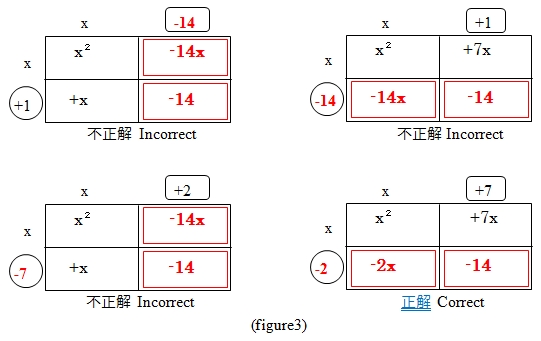
“Expansion & Factorization puzzle 3”
We can use negative numbers as a 2nd step. x2+5x-14 = (x-2) (x+7)
Write “direct product table”, “x2“ and “-14” in the frame, “x” and “x” left and above the upper left box, the same as in example 1.
With trial and error, then we can solve it.
Think of the numbers of and . The numbers times each other is -14. (+1, -14),(-1, +14), (+2,-7) and (-2, +7) groups are considered. At first, I write +1 and -14 in the blank. Then the amount of term of x is -13x. So I know that +1 and -14 are incorrect.
After several trial and errors, I write -2 and +7. The amount of term of x is +5x. So I know -2 and +7 are correct.
I think that an ability of solving expansion & factorization is not connected with talent of math. We can solve this problem by trial and error less than four times.
Please try and enjoy this puzzle!
展開・因数分解パズル2
明日7月1日を701と3ケタの数で表すと、701は素数です。西暦を含めた20170701は3と23と401という3つの素数で割り切れるので、素数ではありません。(明日は土曜日のため今回は前日6/30に発信しました。)次回の発信は9月7日(木)を予定しています。
 前回、皆さんに直積表を利用して因数分解を理解するパズルを紹介しましたね。今回はその第2弾です。
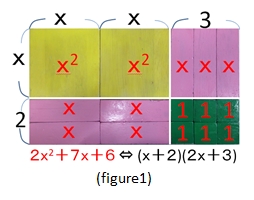
このパズルの3種類の板は、
黄 :一辺xの正方形、面積x2
ピンク:一辺がxと1の長方形、面積x
緑 :一辺1の正方形、面積1
です。
したがって、右の図で、板の種類ごとに面積を表せば、2x2+7x+6となりますし、大きな1つの長方形の面積と考えると、(x+2)(2x+3)となり、2通りの表現で面積を示すことができますね。
これが展開と因数分解の正体です。また、このパズルを簡単に表した(抽象化した)のが直積表です。たすきがけよりも展開・因数分解のしくみが可視化されていますよね。
(数学科 園田)
“Expansion & Factorization puzzle 2”
The last time, I showed “Expansion & Factorization puzzle”. This time, I will explain the structure of expansion & factorization using this puzzle.
Look at the puzzle in “figure1”. “x2” is an area of a square of a side x, “x” is an area of a rectangle with each side of x and 1. “1” is a squares of a side 1. We can say the total area of those pieces is “2x2+7x+6” and can also say “(x+2)(2x+3)”.
This is the true colors of Expansion & Factorization. And “a direct product table” is a model of this puzzle. This model visualizes the structure more clearly than “tasuki – gake”.