Do★Math 数学博物館 Mathematics Museum
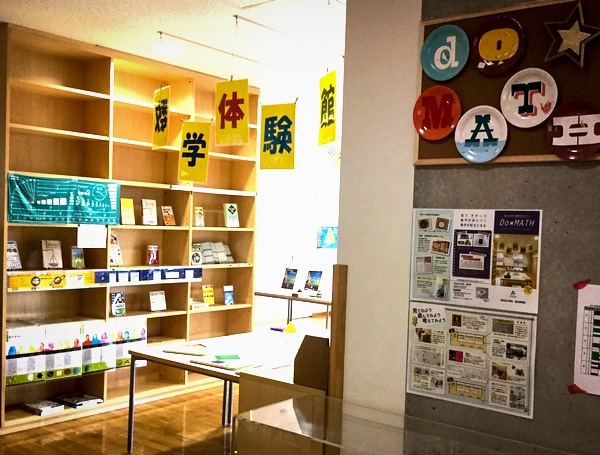
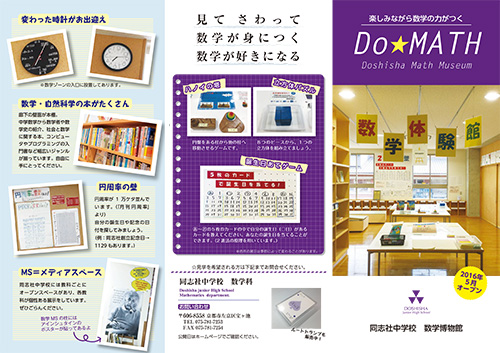
数学科メディアスペースにある、数学だけの博物館では、昔使われていた携帯そろばんや鯨尺ものさし、ピタゴラスの定理パズルや展開・因数分解パズルなど、数学にまつわるさまざまなものを展示をしています。
「Do★Math 数学博物館」からのお知らせ
私たちは、算数・数学を手に触れたり、パズルやゲームでわかりやすく、そして楽しみながら理解できる「Do★Math 同志社中学校数学博物館」を2016年5月にオープンいたしました。展示物の多くを並べた数学科オープンスペース(「数学メディアスペース」)を中心に、数学教室ゾーンを総称して、Do★Mathです。
このページでは、ブログでDo★Mathの展示物を皆さんに紹介していきます。展示内容を知っていただくとともに、数学読み物としても楽しめる連載にしていきたいと考えています。
発行は月2回不定期に、月日を合わせた3ないし4ケタの数字が素数の日に発信します。例えば、5月23日は523と表すことになり、523は素数です。
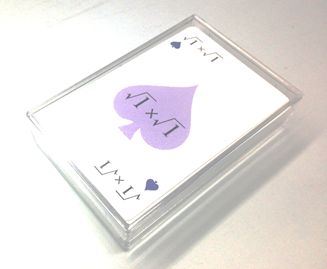
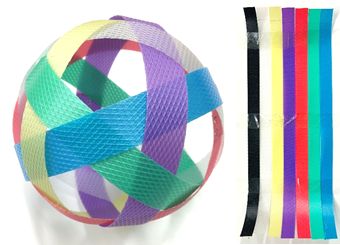
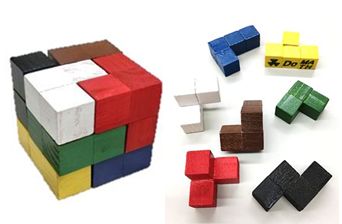
★3種類まとめて購入すると、送料無料!
(2026年1月よりソーマキューブの価格を1セット200円を300円に改定いたしました。)

3Dプリンタで作った、球の体積(公式)を積分的に説明する教具です。スイカを小さく分けたイメージ、球を小さな角すいの集まりとして体積を考えていきます。
自然数の合計はどうなる?
本日10月13日を1013と4ケタの数で表すと、1013は素数です。なんと、西暦を含めた20161013も素数です!
 1+2+3+・・・+14+15 は?
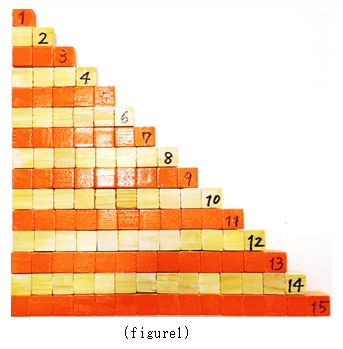
ひとつずつ順に計算していくとたいへんですね。右の階段状の立体(写真1)は、上の式のモデルです。各行の立方体の個数がその行の右端に書いてあります。
だから、階段状の板は、
1+2+3+…+13+14+15(個)
の合計を表しています。
このまま、順にたしていくのはたいへんなので、同じ板を2枚合体させてみましょう。(写真2)
タテが15cm、ヨコが16cmの長方形になりますね。だから、答えは、
15×16÷2 = 120(個)
とな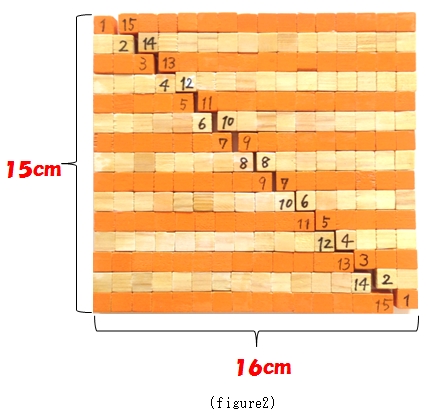 ります! 確かめてみましょう。
数学者ガウス(ドイツ 1777-1855)は、小学生のとき、1から100までの数の合計を求める課題を出されたのですが、彼がどのように解いたか、皆さんもうおわかりですね。
100×(100+1)÷2 = 5050
“What is the sum of natural numbers?”
1+2+3+・・・+14+15=?
It is difficult to calculate one by one.
There is a solid like some stairs. It is a model of the above expression. (figure1)The number on the right side shows the quantum of the small cubes each row.
So this board means the sum of
1+2+3+・・・+14+15=?
Now we unite 2 solids into 1 and we can see a rectangle. (figure2)
The vertical length of this rectangle is 15, the horizontal length is 16.
So the answer is
15×16/2=120
There is famous story about the calculation above.
When a mathematician, Gauss (Germany 1777-1855), was an elementary school student, his teacher asked his students to get the sum of natural number from 1 to 100. He soon solved the problem.
You can see his way of solving.
100×(100+1)/2=5050
自然数の2乗の合計はどうなる?
本日9月29日を929と3ケタの数で表すと、929は素数です。西暦を含めた20160929は17と69761で割り切れるので、素数ではありません。皆さんも計算してみてください。
 1+2²+3²+…+○²
と続く、自然数の2乗の合計はいくつになるのか考えてみましょう。
実は公式があります。1から○までの自然数の2乗の合計は次のような形にまとまります。高校生、大人の方は、○の部分をkやnで学習した記憶があるのではないでしょうか。
1²+2²+3²+…+○²
=1+4+9+…+○²
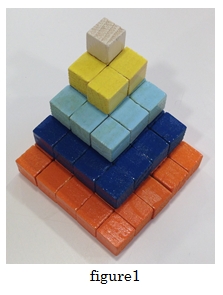
この公式を具体的に立方体の個数として表したのが、この模型です。(写真1)白の立方体が1個、黄が4個、水色が9個、青が16個、橙が25個となっています。この模型は、5² までの合計のモデルにしたので、➄という数字に注目してください。
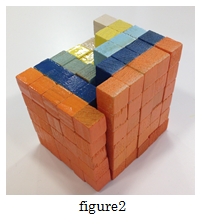 この模型を3セット合体すると、写真2のようになります。
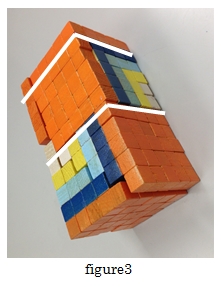
がんばって、6セット合体してみてください。写真3のような直方体になります。
このとき、全ての立方体の個数を直方体の体積として考えることができますね。

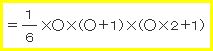
➄を○に直すと、公式ができますね。
 “What is the sum of natural numbers squared?”
Let’s talk about the sum of natural numbers squared.
There is a formula.
1²+2²+3²+…+○²
=1+4+9+…+○²
This model is specifically indicating the formula as numbers of small cubes.
There are 1 piece of white cube, 4 pieces of yellow, 9 pieces of light blue, 16 pieces of blue and 25 pieces of orange.
Please check the number 5 in case of n=5 on this model.
First, we combine 3 sets of this model into 1 solid, as we can see in figure2.
Second, we combine 6 sets of this model into 1, so we can see a rectangular parallelepiped in figure3.
So we can see the length of the rectangular parallelepiped in figure3.

When we change 5 into n, we can get the formula!
誕生日当てゲーム
本日9月7日を907と3ケタの数で表すと、907は素数です。西暦を含めた20160907は13、281、5519で割り切れるので、素数ではありません。皆さんも計算してみてください。
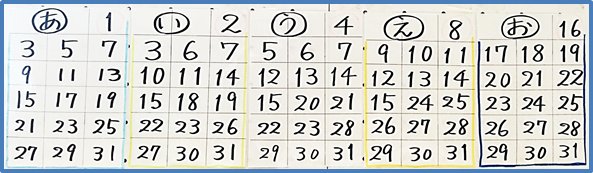
来館くださった子どもたちに人気なのが、誕生日当てゲームです。数字の書かれた5枚のカード(あ)から(お)があり、そこには1から31までの中で16個ずつ数字が書かれています。そして、子どもたちから自分の生まれた日付のあるカードを教えてもらうだけで、誕生日を当てることができるのです。
種明かしをしましょう。それぞれのカードの右上には、(あ)から順に1、2、4、8、16と書いてあり、日付のあるカードの右上の数字を足せば生まれた日付になります。コンピュータで使われている2進法を応用したゲームですが、その原理を中学1年生で学んでいます。
“A game to guess the right birthday”
We will introduce a game to guess the right birthday. It is popular for young visitors in our exhibition. There are five cards (a), (i), (u), (e), (o) in Japanese characters. Each card shows 16 numbers from 1 to 31.
First, a customer chooses the cards that show one’s birthday in five cards.
Next, we check the number ‘1’, ‘2’,’4′, ‘8’ and ’16’ in upper right on the cards that the customer choice. We add the numbers and get one’s birthday.
This is a game that applies the binary number system used by computers. Our 7th grade students study its principle.
皆さんは弘中又一さんを知っていますか?
本日8月23日を823と3ケタの数で表すと、823は素数です。西暦を含めた20160823は13、89、139で割り切れるので素数ではありません!
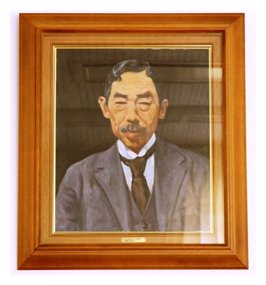 弘中又市さん(1873-1938)は、1912年から1932年まで同志社中学校で数学の教員をしていたのですが、以前、松山中学校で働いたことがありました。(1895-1896) そして、そこには、当時、英語の教員だった夏目漱石がいたのです。そうです。弘中又一さんは夏目漱石が書いた「坊ちゃん」のモデルだったのです。
彼の肖像画と資料が本校3階数学MSに展示してあります。
“Do you know Hironaka Mataichi?”
He worked as a math teacher at our school from 1912 until 1923. Before his career at our school, he worked at Matsuyama Junior High School from 1895 until 1896.
Natsume Soseki, who is a famous Japanese writer, also worked there. So, Hironaka Mataichi is a model of ‘Botchan’, that is a novel of Natsume Soseki.
We have his portrait and other data about him on the third floor in our math space.
数学教室には名前があります
本日7月19日を719と3ケタの数で表すと、719は素数です。西暦を含めた20160719はなんと23で3回割り切れるので、素数ではありません。皆さんも計算してみてください。
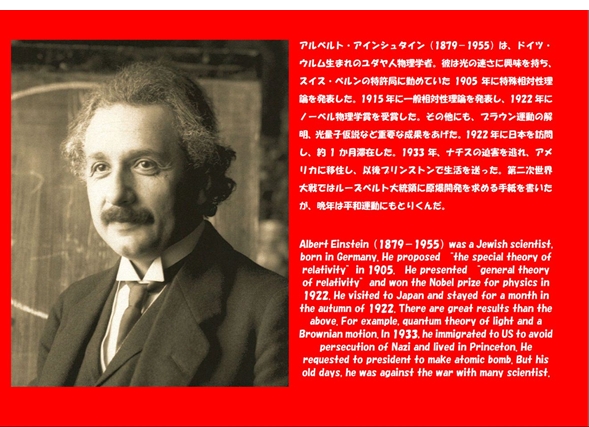
本校は教科センター方式の学校運営を採用しており、教科専門教室があります。数学教室は全部で6教室あり、教科ステーションと呼ぶ教員室1部屋と合わせて 7室に数学者、科学者の名前をつけています。順に、数学1「ピタゴラス」、数学2「エラトステネス」、数学3「アインシュタイン」、数学4「伊能忠敬」、数学5「ガリレオ」、数学6「アルキメデス」、教科ステーションは「オイラー」です。今後、2つのMS(メディアスペース)にも名前をつけていきます。
“Each classroom has its own name.”
We have six math classrooms in what we call “Subject Centered Style” in Japan.
We gave the names of famous mathematicians or scientists to the six classrooms and the teacher’s “station” staff room.
Math 1 is “Pythagoras”, math 2 is “Eratostenes”, math 3 is “Einstein”, math 4 is “Ino Tadataka”, math 5 is “Galileo”, math 6 is “Archimedes”, and “Euler” for the staff room.
We will also give names to two the media spaces next.