身体で感じる橋梁構造
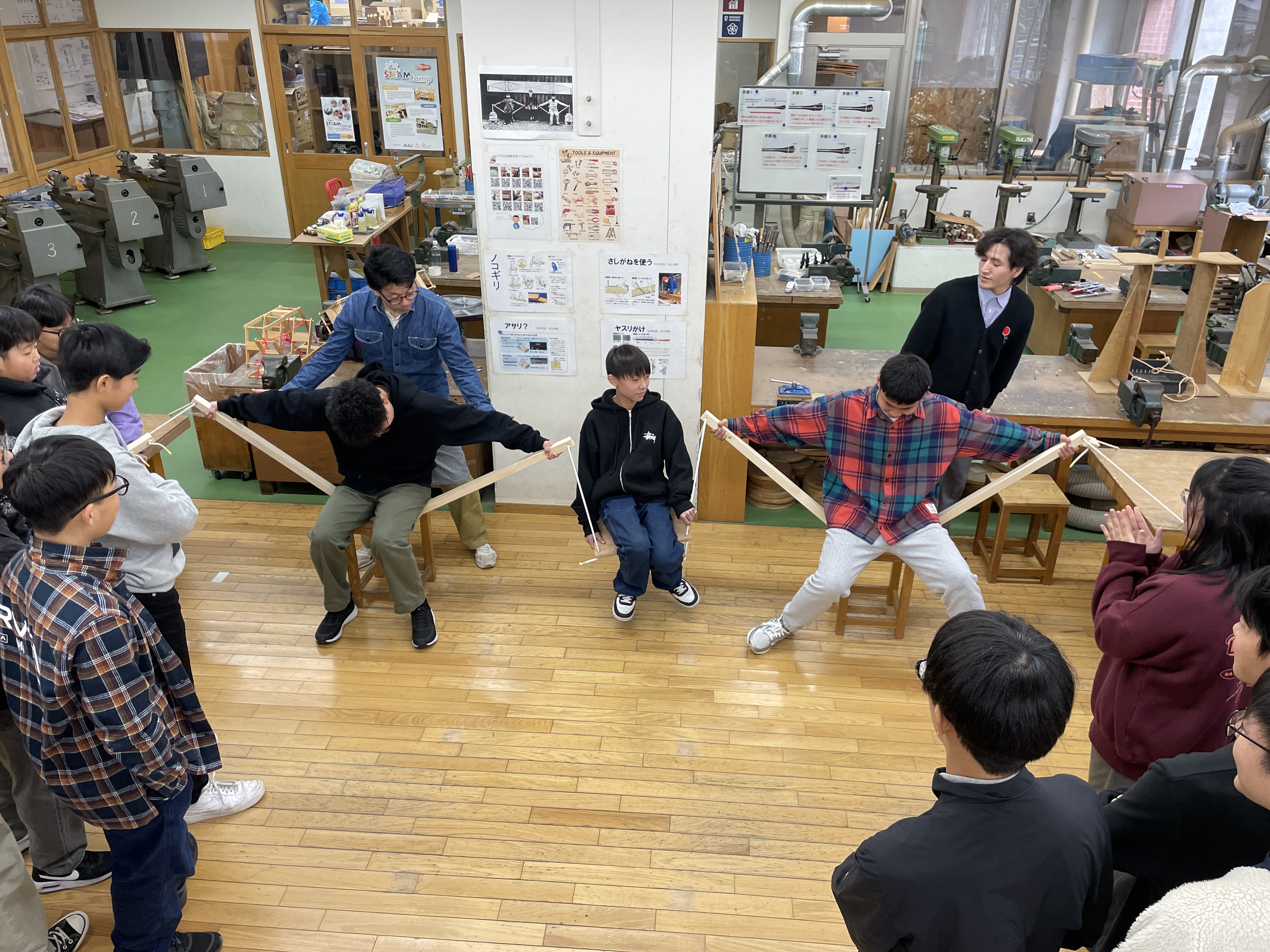
フォース鉄道橋のデモンストレーションを中学生が追体験
強くて軽い橋を設計することは、思っている以上に難しい。そのことを、生徒たちは自らの身体を使った再現を通して実感しました。
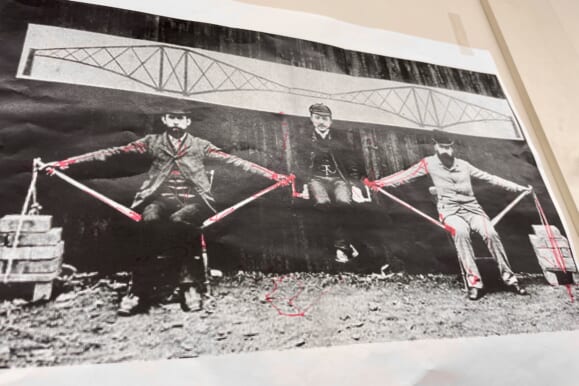
本授業で扱ったのは、およそ140年前の歴史的なデモンストレーションです。スコットランドのテイ湾にかかるフォース鉄道橋の建設前に行われたもので、当時橋の崩壊事故の惨劇を経て、橋梁建設の信頼を取り戻すべく行われました。人間が構造の一部となり建設予定のフォース鉄道橋の構造を表現されました。中央に写っているのは、日本人の渡辺嘉一とされています。日本の土木工学の父と呼ばる渡辺は、1883年に工部大学校(東京大学工学部)を卒業され、イギリスにて、フォース鉄道橋の設計・建設に関わりました。このフォース鉄道橋が開通した1890年とは、同志社が設立される15年後です。日本が近代国家への道を歩み始めた時代、ほぼ同じ時期に誕生したことを考えるととても親しみを感じます。
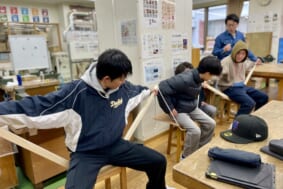
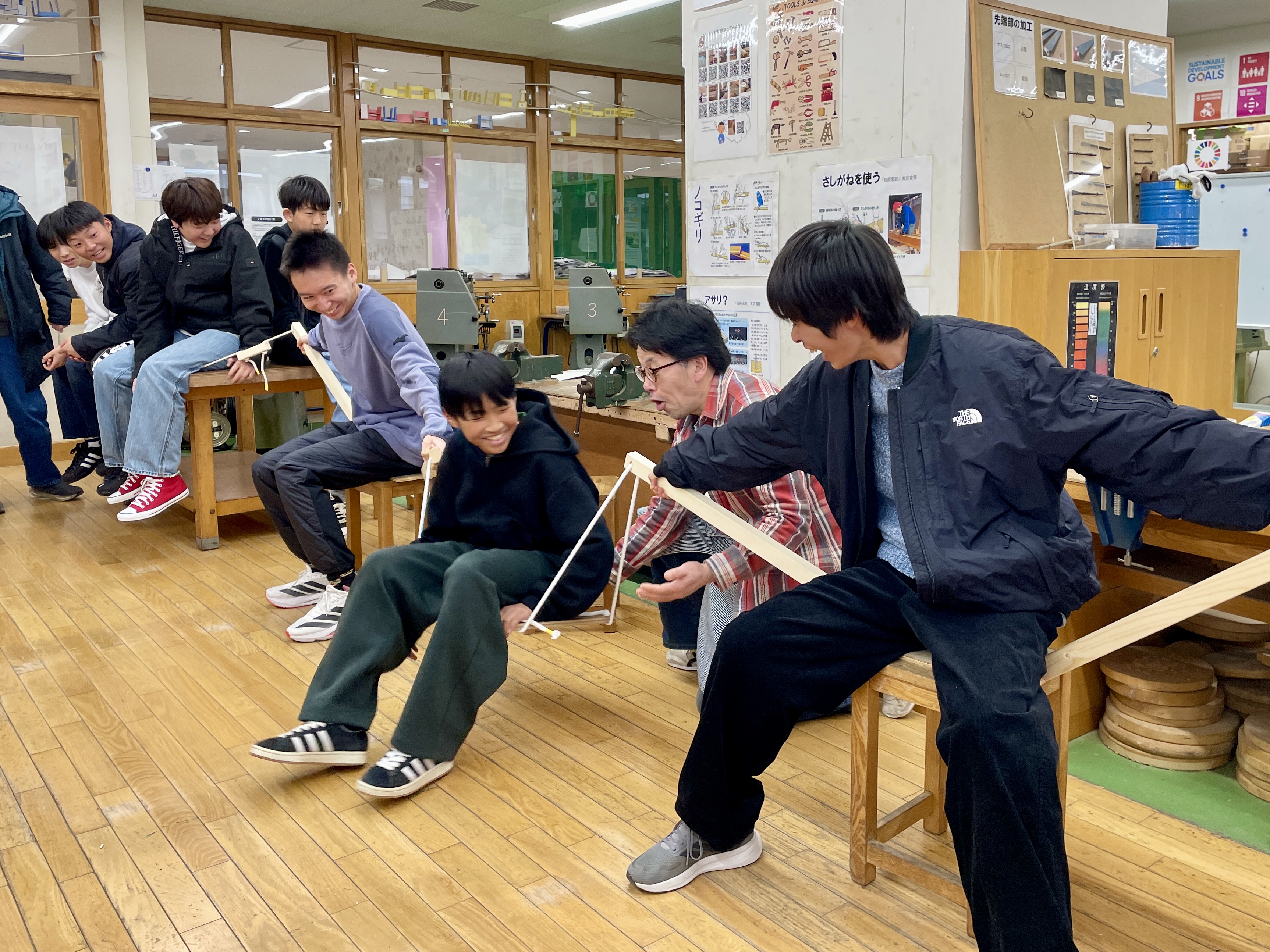
今回、生徒たちが再現したこの歴史的デモンストレーションは、椅子に座った二人が両腕を伸ばし、その手で中央の一人を支えます。外側に延びたロープは、思い机につながっており、アンカレイジとなってバランスを取ります。生徒たちはこの活動を通じ、橋を支えるのは単なる柱ではなく、引っ張られる部材と圧縮される部材のバランスで成り立っていることを学びました。中央の人の重みがかかった時、橋脚の役割を演じる二人に重みがかかり、その重みを自分の身体で受け止めます。椅子に座った生徒は、「腕が引っ張られていく感じで、引っ張られる両腕に真ん中の身体は沈んで行く感じ」(西村さん)と述べています。上には「引張」の力がかかり、胴体には圧縮の力がかかっていることを表現されています。
さらに、
・「体全体を通して持つと、より頑丈な橋としての役割を持つ」(梯さん)
・「私はてっきり持っている棒が折れるんじゃないかと思いましたが、棒は折れず、真ん中の人を支えている両サイドの人たちが苦しそうでした」(寺町さん)
と述べており、このデモンストレーションを見ることを通して、構造全体へ目を向けるきっかけをつかんでおられます。
また、引張と圧縮の構造をイメージしたあとさらに、適材適所の工夫に思いを巡らす生徒もいます。
・「同じ素材ではなく、縮むのに強い材料は上に、伸びるのに強い材料は下になど材料によって使う場所をかえるということがとても大切だとわかった。」(守崎さん)
・材料が「少なくても力を分散させることで、強くて安定した構造を作れる」(吉田さん)
・「素材を使い分けて、その近い道によって変えると、何通りにも様々な場所で使える」(上野さん)
など、デモをみただけで鋭い考察が行われています。テキストにでてくる知識、「トラス構造」、「圧縮」、「引張」という言葉が、生きた実感として身体にインストールされていることを予感させてくれます。
また、「通学で橋を通るときに、橋がどんな形をしているのか観察してみようと思う」(今谷さん)などこのデモをきっかけにして今まで興味もなかったものにたいして、新しい気づきや問いの視点が芽生えていることがうかがえる生徒もいました。橋は通り過ぎてしまえば、ただのなんてことはない風景の一つにすぎません。しかし、小さな体験ではあるものの、良質な知識のセットと良識なやり方でその体験をくぐり抜けるとき、書面上の知識が自分の身体に浸み込んでくるのだと思います。次回の授業で用意されているブリッジ・コンテストの設計において、根拠のある製作アイデアへとつながる良い機会であったと期待しています。(技術科 沼田 和也)
参考資料)
1)身体で感じる体験の余韻(https://jhs.js.doshisha.ac.jp/headline/embodied-sense-of-scale/)類設計とのコラボ授業にて、フォース鉄道橋にもつながっています。
2)「引っ張り」を体感!~人間フォース橋~(https://www.gijyutu.com/kyouzai/kakou/hipari.htm)技術ドットコム
3)橋の構造を見抜く洞察力(https://jhs.js.doshisha.ac.jp/manabi/analizing/)
4)The Forth Bridge Inscribed on the World Heritage List in 2015
5)三浦基弘・前田研一 カレンチレバー橋の歴史 JSCE 土木学会 2025 http://library.jsce.or.jp/jsce/open/00902/2005/25-0085.pdf
6)1887年に行われた構造の説明用モデル→The Forth Bridge: Building an Icon(https://openglam.org/2015/06/02/the-forth-bridge-building-an-icon/?utm_source=chatgpt.com)
7)スコットランドで学んだ 『日本土木史の父』渡邊嘉一の志(https://www.japanjournals.com/feature/survivor/10052-
kaichi-watanabe.html?utm_source=chatgpt.com)
Students Re-enact the Forth Bridge Demonstration
In this lesson, junior high school students re-enacted, using their own bodies, a structural demonstration of the Forth Bridge that was originally carried out in Scotland in the late nineteenth century. By retracing this historic demonstration—conducted in the aftermath of a catastrophic bridge collapse to restore public trust—students gained a concrete understanding of how challenging it is to design a bridge that is both strong and lightweight.
Through an activity in which students seated on chairs supported one another, they learned through bodily sensation that a bridge is not supported solely by vertical pillars, but is sustained by a balance between tensile and compressive forces. Differences in how forces were applied led students to shift their attention toward the structure as a whole and to consider the specific roles played by individual members.
Furthermore, some students came to recognize the importance of placing materials appropriately according to their properties, and that even with a small amount of material, a stable structure can be achieved by effectively distributing forces. Technical terms encountered in textbooks—such as “truss structure,” “compression,” and “tension”—began to take root as knowledge grounded in lived experience rather than abstract definitions.
In addition, the demonstration prompted some students to observe the bridges along their daily commute more closely, signaling the emergence of a perspective that questions and reinterprets ordinary scenery. When experience and knowledge are meaningfully connected in this way, learning becomes embodied, and students are better prepared to develop well-founded design ideas for the upcoming bridge contest.
(Technology & Engineeering teacher, Kazuya Numata)
— Below is a list of the students’ observations —
・“What I learned from the experiment is that it is very important to change where materials are used depending on their properties—for example, placing materials that are strong under compression on top, and materials that are strong under tension underneath. I also realized that it is important not to be bound by the fixed idea that the same material must be used everywhere.”(Morisaki)
・“If you try to support the weight with just one hand, it is too heavy, but when there is support at both ends, the load can be lifted. So instead of strengthening only the center, it is important to think about the ends as well.”(Ishikawa)
・“Through the experiment of physically experiencing a bridge, I thought that the two people acting as the bridge should support the weight not only with their arms but with their whole bodies, which would make the bridge stronger.”(Hashimoto)
・“In the truss-bridge method where two people lift one person, I first thought the stick I was holding might break, but it did not. Instead, the people on both sides supporting the center looked like they were struggling. It felt similar to the principle of a lever, and I learned a lot.”(Teramachi)
・“I learned that depending on the structure, a truss bridge can support very heavy loads. I also thought that when this structure was first developed, it must have caused a revolution in physics at that time.”(Shinno)
・“I learned that bridges are not supported only by pulling forces, but that the entire structure is supported by using pillars underneath as well.”(Ono)